
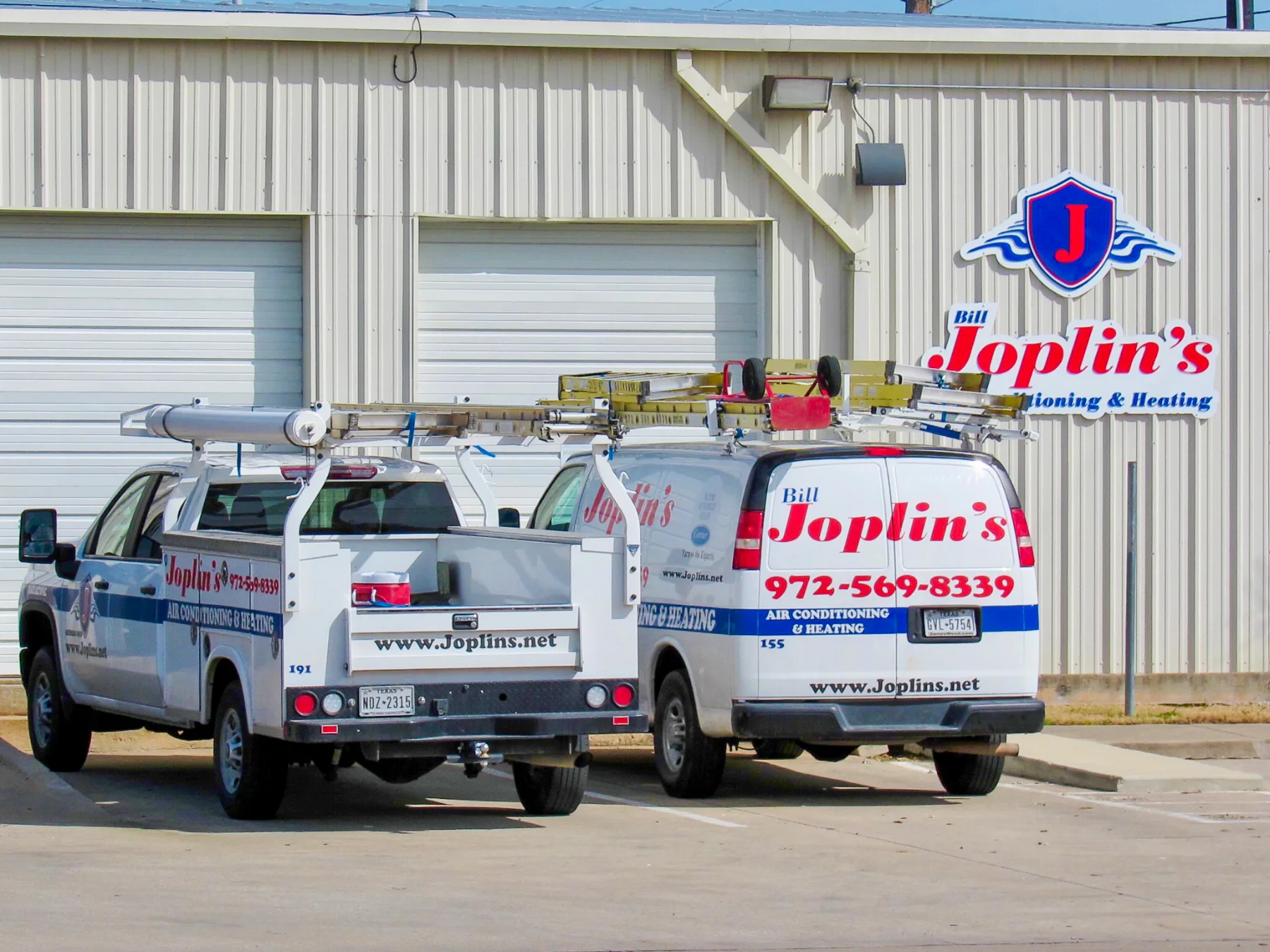
Sheet Metal Fabrication in Lowry Crossing, TX
When a return-air plenum does not match the blower housing, or a supply run has to bend around a roof joist that was never on the original plans, an off-the-shelf part will not do the job. That is the moment custom sheet metal earns its keep. In Lowry Crossing, TX, where homes range from decades-old farmhouses to newer construction with tight mechanical rooms, the difference between a duct system that performs and one that fights itself often comes down to fabricated metal that fits the actual space instead of an approximation of it. Bill Joplin's Air Conditioning & Heating has been fabricating and installing this kind of custom ductwork since 1978, and the shop skills behind it remain central to how we deliver quiet, efficient heating and cooling.
Why Custom Sheet Metal Still Matters in Modern HVAC
Flexible duct and pre-formed fittings have their place, but they cannot solve every airflow problem. A blower moving 1,200 cubic feet per minute needs a plenum sized to accept that volume without creating turbulence, and a transition that steps down too quickly will spike static pressure and rob the system of capacity. Fabricated sheet metal lets us build the exact geometry a given installation requires, whether that means a tapered trunk line, an offset boot to clear framing, or a custom return grille box sized to a wall cavity.
Rigid metal ductwork also holds its shape over decades. Unlike flex duct, which can sag, kink, or compress in an attic, galvanized sheet metal keeps its cross-section and delivers consistent airflow year after year. For homeowners across Lowry Crossing and the broader service area covered by Bill Joplin's Air Conditioning & Heating, that translates into stable comfort and fewer callbacks. When we fabricate a piece in the shop, we build it to survive the temperature swings and attic heat that this part of Texas produces every summer.
Materials and Technical Specifications We Work With
Choosing the right metal and gauge for each application is where craftsmanship meets engineering. We select material based on the load, the location, and the airflow demands of the system. Heavier gauges resist deformation on large trunk lines, while lighter gauges are appropriate for smaller branch runs where weight and cost both matter.
- Galvanized steel: our standard for most residential and light commercial ductwork thanks to its corrosion resistance and rigidity. Common gauges range from 26 to 30 depending on duct dimensions.
- Aluminum: lighter than steel and useful in corrosive or high-humidity locations, often chosen for specialty fittings and lightweight transitions.
- Stainless steel: reserved for demanding environments such as exhaust applications where heat and moisture would degrade a standard coating.
Beyond material selection, dimensional accuracy drives performance. A plenum that is a quarter inch off can leak conditioned air or force a strained seam. We size our transitions to keep air velocity within a range that avoids both noise and pressure loss, generally aiming to keep static pressure under the equipment manufacturer’s rated maximum. Seams are locked and sealed, joints are fastened, and every fabricated section is checked against the field measurements before it leaves the bench. This attention to tolerance is what keeps a system operating at its designed capacity rather than a fraction of it.
Our Fabrication Process From Measurement to Installation
Good sheet metal fabrication work starts long before a shear touches a sheet. It begins with a site visit where we measure the space, note obstructions, and confirm the airflow requirements of the equipment. Only then do we move to layout and cutting. We treat fabrication as a controlled sequence rather than a rushed improvisation, and that discipline shows up in the finished result.
- Field measurement and load review: we document duct dimensions, framing constraints, and the calculated airflow the system must deliver.
- Layout and cutting: patterns are marked and material is cut to precise dimensions, accounting for seam allowances and connection points.
- Forming and seaming: flat stock is bent into plenums, transitions, elbows, and boots, then locked and fastened for structural integrity.
- Sealing and finishing: joints are sealed to limit leakage, and edges are cleaned so the piece installs safely and connects cleanly.
- On-site installation: the fabricated components are hung, supported, and integrated with the rest of the duct system, then tested for proper airflow.
Because we control each of these steps, we can respond to surprises in the field. If a rafter sits where a duct needs to run, we can fabricate an offset on the spot rather than forcing a compromise that hurts performance. That flexibility is one of the practical advantages of keeping fabrication skills in-house rather than relying entirely on stock parts.
Common Situations Where Fabricated Metal Solves the Problem
Custom sheet metal shows up across a wide range of jobs. When a homeowner in Lowry Crossing replaces an aging furnace with a higher-capacity unit, the old plenum rarely matches the new blower, and a fabricated transition bridges the gap without choking airflow. During a full system replacement, we frequently build a new supply and return plenum from scratch so the new equipment breathes exactly as the manufacturer intended.
Older homes present their own challenges. Framing was often built without ductwork in mind, so branch runs must weave around joists and headers. Fabricated boots and offsets let us route air to every register without the sharp bends that flex duct would create. On the commercial side, rooftop units and larger air handlers demand robust, precisely sized transitions and curbs that stand up to weather and vibration. In each case, the goal is the same: move the right volume of air to the right place with the least resistance and the least noise.
These solutions matter throughout the communities we serve, including Mckinney, Allen, Melissa, Prosper, Fairview, Lucas, Plano, and Princeton, TX, where the mix of residential and commercial buildings keeps our fabrication work varied. Whether the job is a quiet bedroom that never seemed to cool properly or a retail space that needs balanced airflow across a large floor plan, the fabricated metal is often the quiet hero that makes the whole system work.
How Sheet Metal Quality Affects Comfort and Efficiency
Every leak, every sharp turn, and every mismatched connection costs energy and comfort. Air that escapes through a poorly sealed seam is air you paid to condition, and it never reaches the room. Turbulence created by an abrupt transition forces the blower to work harder, which raises energy use and shortens equipment life. Precisely fabricated metal ductwork addresses both problems at the source by keeping air where it belongs and moving it smoothly.
There is also a comfort dimension that homeowners feel every day. Properly sized ductwork keeps velocity in a range that avoids whistling and drafts while still delivering enough air to each room. When temperatures across a house even out, the thermostat stops chasing hot and cold spots, and the equipment cycles less frequently. That balance is difficult to achieve with generic parts alone, which is why fabrication remains a core capability at Bill Joplin's Air Conditioning & Heating.
Work With a Contractor That Builds Its Own Ductwork
As a leading residential HVAC contractor serving McKinney and the surrounding communities, we bring decades of hands-on fabrication experience to every project. Founded in 1978, Bill Joplin's Air Conditioning & Heating has built and installed countless custom duct components, and that background informs how we approach AC repair, furnace repair, AC service, and complete system installation. Sheet metal work is not a side skill for us. It is part of how we make sure the systems we install and service perform the way they should.
If you are planning a system upgrade, dealing with rooms that will not stay comfortable, or building new construction that needs ductwork designed around your space, custom fabrication may be exactly what your project needs. Reach out to Bill Joplin's Air Conditioning & Heating in Lowry Crossing, TX, and let our shop and field teams build a duct system that fits your home and your equipment precisely, so you get the quiet, efficient comfort you expect for years to come.
Upgrade your HVAC system today with little to no down payment!
Learn how you extend the life of your system and save on utility bills.