
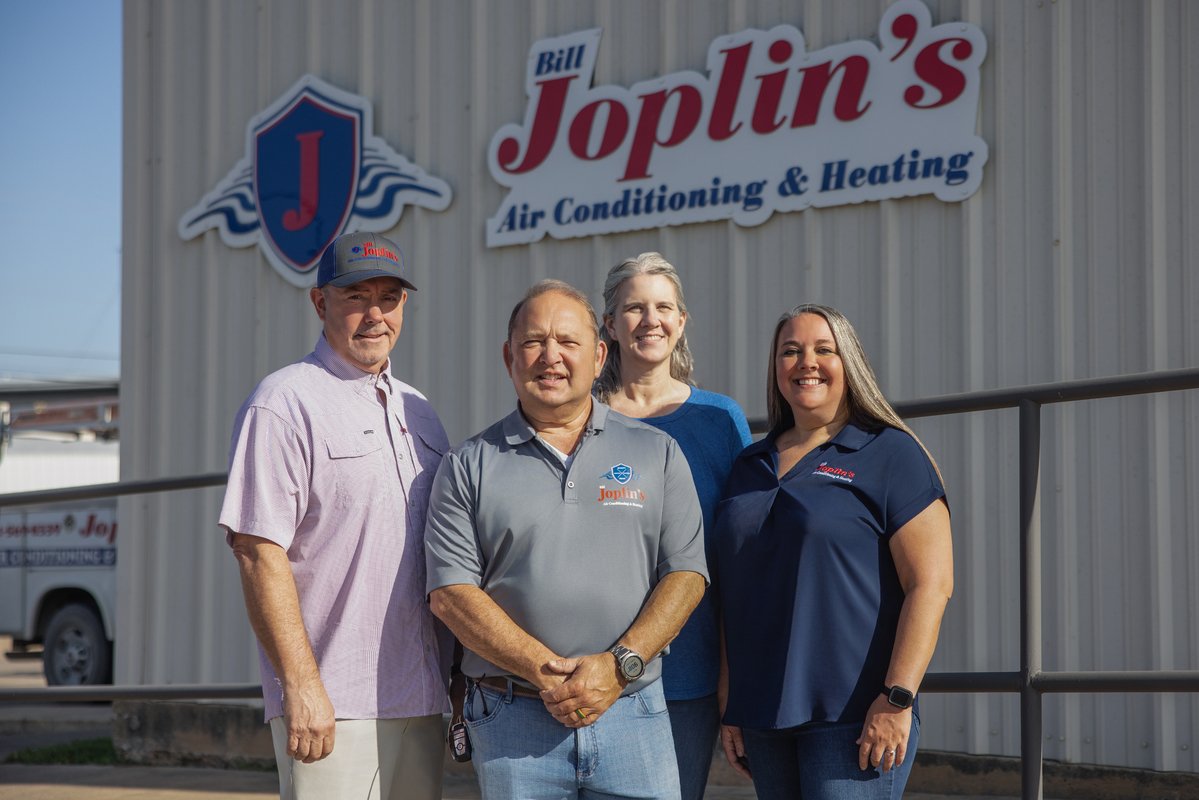
Commercial HVAC Replacement in Blue Ridge, TX
When a Commercial System Reaches the End of Its Service Life
A commercial HVAC system that no longer holds setpoint, cycles more often than it runs, or drives utility costs upward month after month is telling you something. Compressors wear, heat exchangers crack, and refrigerant circuits develop leaks that repeated repairs cannot resolve permanently. At some point, continued repair spending on aging equipment costs more than a planned replacement would across the same period. For business owners in Blue Ridge, TX, that tipping point often arrives faster than expected because commercial equipment runs longer hours and carries heavier loads than residential systems.
Bill Joplin's Air Conditioning & Heating has handled commercial replacement work since 1978, and we approach every project as an engineering task rather than a simple swap. Replacing a rooftop unit or a split system in a working building means accounting for load, ductwork condition, electrical capacity, and the disruption a shutdown causes to your operation. We plan the work so that your business keeps running with minimal interruption, and we size the new equipment to the actual demand of the space rather than reusing whatever tonnage happened to be there before.
Signs Your Building Needs Replacement Rather Than Repair
Deciding between another repair and a full replacement is rarely obvious from a single symptom. We look at the whole picture: the age of the equipment, the frequency and cost of recent repairs, the availability of replacement parts, and the efficiency the system delivers compared with current models. Equipment that uses discontinued refrigerants such as R-22 becomes progressively more expensive to service because the refrigerant itself is scarce and costly. A system that needs a recharge every season is losing refrigerant somewhere, and the environmental and financial cost of chasing those leaks adds up quickly.
Beyond mechanical failures, there are performance signs that point toward replacement. Uneven temperatures across a building, humidity that the system cannot control, rising energy bills without a change in usage, and noise levels that disturb customers or staff all suggest that the equipment is no longer matched to the building’s needs. When we evaluate a system, we consider several conditions together:
- Age past the 15-year mark: most commercial units are designed for a service life in that range, and efficiency drops well before mechanical failure.
- Repeated compressor or heat exchanger issues: these are the most expensive components, and their failure often signals broader wear.
- Refrigerant type and availability: obsolete refrigerants make even minor repairs disproportionately costly.
- Rising energy costs: a modern high-efficiency unit can cut consumption enough to offset a meaningful portion of the replacement over time.
- Comfort complaints: hot and cold spots, poor humidity control, and inconsistent airflow indicate a system that no longer serves the load.
How We Size and Specify Replacement Equipment
Correct sizing is the single most important decision in a commercial replacement, and it is the step most often done poorly by contractors who simply match the old nameplate tonnage. An oversized unit short-cycles, which wastes energy, wears components prematurely, and fails to remove humidity because it satisfies the thermostat before the air conditioning has run long enough to dehumidify. An undersized unit runs continuously and still cannot hold setpoint during peak load. Both mistakes cost money and comfort.
Bill Joplin's Air Conditioning & Heating performs a load calculation based on the building itself: square footage, ceiling height, insulation values, window area and orientation, occupancy, and internal heat gains from lighting and equipment. We use these figures to determine the true cooling and heating demand, then select equipment that meets it with appropriate reserve capacity rather than gross oversizing. We also review the existing ductwork and distribution to confirm it can carry the airflow the new unit is designed to deliver. A high-efficiency unit paired with restrictive or leaking ducts never reaches its rated performance, so we address the delivery system as part of the specification.
Efficiency Ratings and What They Mean for Your Operating Costs
Commercial equipment is rated by several standardized metrics, and understanding them helps you weigh the long-term value of a replacement. SEER2 and EER2 describe cooling efficiency, with higher numbers indicating less energy consumed per unit of cooling delivered. For heating, gas units are rated by AFUE, and heat pumps by HSPF2. A newer unit with a substantially higher rating consumes noticeably less electricity or gas across a cooling and heating season, and in a commercial building that runs long hours, the difference compounds quickly.
We help you find the point where efficiency investment makes sense for your particular usage pattern. A building open twelve hours a day, six days a week justifies a higher-tier unit far more readily than one used only a few hours daily. Variable-speed compressors and multi-stage systems adjust output to match demand, which improves comfort and reduces the energy spikes that come from equipment that only runs full-on or fully off. We explain these options in plain terms so you can make a decision based on how you actually use the space, not on a sales pitch.
Our Replacement Process From Assessment to Startup
Every commercial replacement we perform follows a disciplined sequence designed to protect your operation. We begin with a site assessment that documents the existing equipment, electrical service, gas supply, structural support for rooftop units, and the condition of the ductwork and controls. From there we prepare a specification and a project plan that schedules the work to limit downtime, often coordinating around your business hours or scheduling a phased changeover for buildings with multiple units.
On installation day, we handle the safe recovery of existing refrigerant, the removal and disposal of the old equipment, and the placement of the new unit with proper curb adapters, electrical connections, and condensate management. We commission the system after installation, which means we verify refrigerant charge, airflow, temperature split, and control operation against the manufacturer’s specifications rather than assuming the unit works because it turns on. Proper commissioning is what separates equipment that meets its rated efficiency from equipment that quietly underperforms for years.
Serving Blue Ridge and the Surrounding Region
As a leading HVAC contractor based out of McKinney, TX, Bill Joplin's Air Conditioning & Heating brings the same commercial expertise to Blue Ridge, TX that we provide across Mckinney, Allen, Melissa, Prosper, Fairview, Lucas, Plano, and Princeton, TX. We understand the demands that North Texas summers place on commercial cooling and the way sudden cold snaps test heating systems, and we specify equipment that performs reliably through both extremes.
We work with retail spaces, offices, restaurants, warehouses, and mixed-use buildings, and we tailor each replacement to the way the building is used and occupied. Whether you operate a single rooftop package unit or a bank of systems serving different zones, we can plan and execute a replacement that improves comfort, lowers operating costs, and gives you dependable service for years to come. When you are ready to discuss replacing aging commercial equipment, Bill Joplin's Air Conditioning & Heating is prepared to evaluate your building and guide you through the options that fit your operation.
Upgrade your HVAC system today with little to no down payment!
Learn how you extend the life of your system and save on utility bills.