
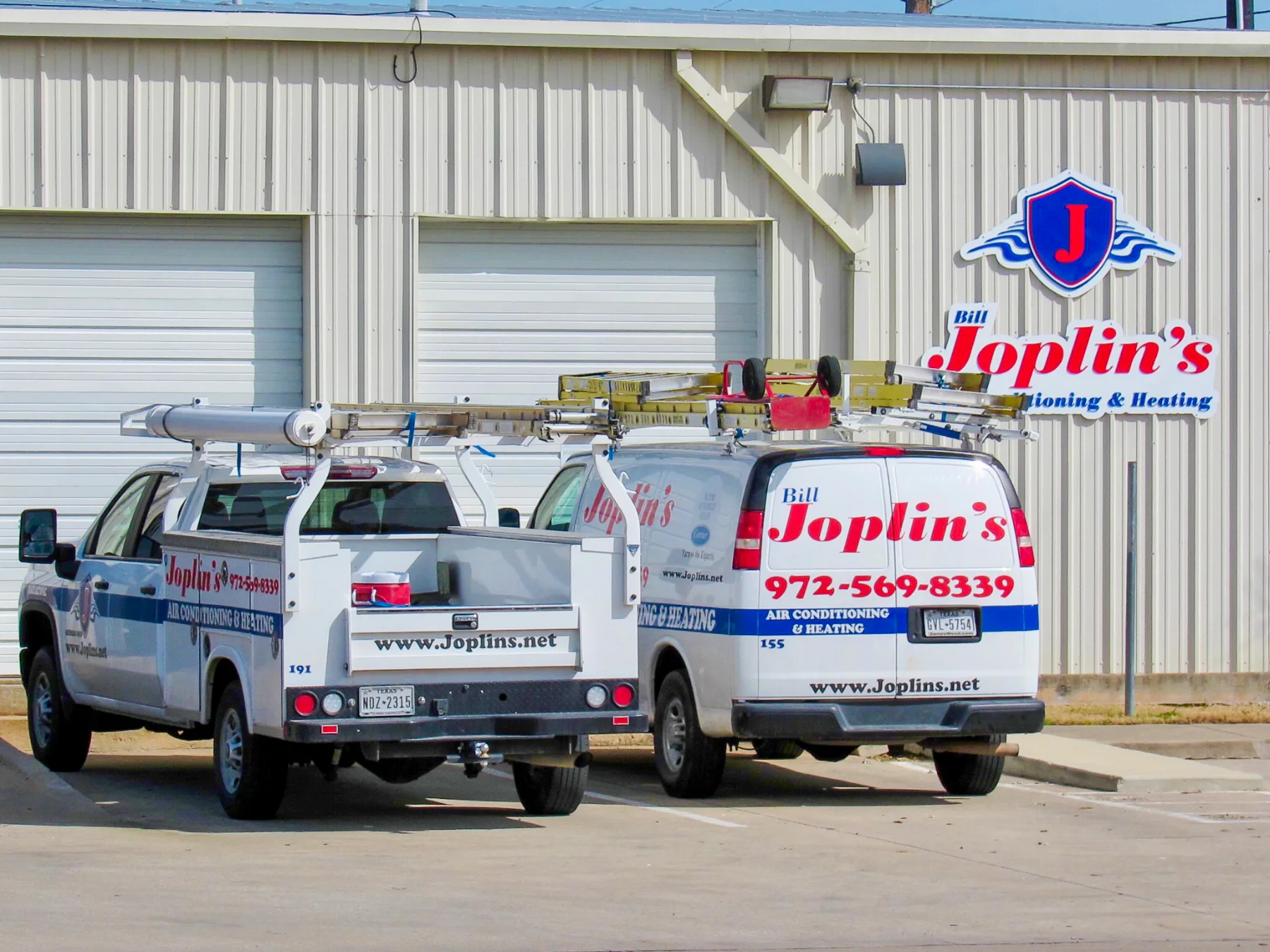
Commercial AC Installation in Plano, TX
Commercial AC Installation in Plano, TX
When it comes to commercial AC installation in Plano, TX, the stakes are significantly higher than a typical residential project. Commercial buildings demand precision engineering, careful load calculations, and systems designed to handle the unique cooling challenges of office spaces, retail environments, restaurants, medical facilities, and warehouses. At Bill Joplin’s Air Conditioning & Heating, we bring decades of expertise to every commercial installation project. Founded in 1978, we have grown into a leading HVAC company providing heating and cooling services to McKinney, TX, and the surrounding communities, including Plano, Allen, Fairview, Prosper, and Melissa. Our deep roots in North Texas mean we understand the extreme summer temperatures that push commercial cooling systems to their limits, and we design installations that deliver reliable performance year after year.
Plano’s commercial landscape has expanded dramatically over the past two decades, with major corporate relocations, thriving retail corridors, and a growing number of mixed-use developments. This growth means more businesses than ever need properly engineered AC systems that can maintain comfortable indoor environments while keeping energy costs manageable. Whether you are building out a new commercial space or replacing an aging system that no longer meets your facility’s demands, our team approaches every project with the same commitment to quality and long-term performance.
Understanding the Commercial AC Installation Process
Commercial AC installation is a multi-phase process that begins long before any equipment arrives on site. The first critical step is a comprehensive assessment of the building’s cooling requirements. We evaluate square footage, ceiling heights, window placement and glazing, insulation levels, occupancy patterns, heat-generating equipment, and ventilation needs. For a restaurant in Plano, the thermal load from commercial kitchen equipment dramatically shifts the calculation compared to an office suite of the same size. These variables must be accounted for with precision to avoid oversizing or undersizing the system, both of which lead to inefficiency, higher utility bills, and premature equipment failure.
Once the load calculation is complete, we move into system design and equipment selection. Commercial installations frequently involve rooftop units, split systems, variable refrigerant flow technology, or chilled water systems depending on the building’s configuration and the client’s budget. We work closely with building owners and property managers to select equipment that balances upfront investment with long-term operating costs. After design approval, our installation teams coordinate with general contractors, electricians, and other trades to ensure ductwork fabrication, refrigerant piping, electrical connections, and thermostat or building automation integration all proceed on schedule. The final phase includes rigorous system testing, airflow balancing, and commissioning to verify that every zone reaches its target temperature efficiently.
Key Considerations for Commercial Installations in Plano
Plano sits squarely in ASHRAE Climate Zone 3A, characterized by hot, humid summers where outdoor temperatures regularly exceed 100 degrees Fahrenheit. This climate profile places enormous demands on commercial cooling systems, making proper equipment sizing and installation quality absolutely essential. A system installed with incorrect refrigerant charge, poorly sealed ductwork, or inadequate airflow will struggle during peak summer months, resulting in tenant complaints, lost productivity, and expensive emergency repairs.
Several factors deserve special attention during any commercial AC installation in this region:
- Energy efficiency ratings and compliance with current Texas Mechanical Code and International Energy Conservation Code requirements, which have become increasingly stringent in recent years
- Zoning capabilities that allow different areas of a commercial building to maintain independent temperature settings based on occupancy and usage patterns throughout the day
- Indoor air quality integration including proper ventilation rates, filtration systems rated MERV 13 or higher, and humidity control features that prevent mold growth in North Texas humidity
- Equipment accessibility for future maintenance ensuring rooftop units, air handlers, and condensing units are positioned with adequate clearance for service technicians to perform routine maintenance and eventual repairs
Types of Commercial Buildings We Serve
Every commercial building type presents its own set of challenges that influence the AC installation approach. Retail spaces in Plano’s shopping centers require systems that respond quickly to fluctuating foot traffic and compensate for the thermal impact of frequently opening entrance doors. Medical and dental offices demand precise temperature and humidity control to protect sensitive equipment and ensure patient comfort. Office buildings housing multiple tenants need flexible zoning that allows individual suites to operate independently without impacting neighboring spaces.
Restaurants and food service establishments represent some of the most demanding commercial installations we handle. The combination of commercial cooking equipment, exhaust hoods pulling conditioned air out of the building, and high occupancy densities creates enormous cooling loads concentrated in relatively small spaces. A poorly designed system in a restaurant environment can result in dining areas that are uncomfortably warm, kitchen staff working in dangerous heat conditions, and energy bills that eat directly into profit margins. We design these systems with dedicated makeup air units, enhanced dehumidification, and strategic supply air placement to overcome these challenges.
Energy Efficiency and Modern Technology
The commercial HVAC industry has undergone a significant transformation driven by advances in compressor technology, refrigerant management, and smart building controls. Variable speed compressors and electronically commutated motors now allow commercial systems to modulate their output in response to real-time conditions rather than cycling between full power and off. This technology reduces energy consumption by as much as 30 to 40 percent compared to conventional fixed-speed equipment, according to Department of Energy estimates.
We also install systems compatible with building automation platforms that provide facility managers with granular visibility into system performance. These platforms monitor refrigerant pressures, compressor amperage, supply and return air temperatures, and filter condition in real time. When anomalies appear, the system generates alerts that allow proactive intervention before a minor issue escalates into a costly breakdown. For businesses in Plano operating during the brutal summer months, this kind of monitoring can mean the difference between a minor adjustment and a full day of lost business due to an overheated building.
Why Proper Installation Matters More Than Equipment Selection
Industry research consistently shows that installation quality has a greater impact on system performance than the brand or model of equipment chosen. Studies from the National Institute of Standards and Technology indicate that improper installation practices can reduce system efficiency by 20 to 30 percent from day one. Common installation deficiencies include incorrect refrigerant charge, duct leakage, undersized electrical circuits, and failure to properly commission the system after startup. These issues compound over time, shortening equipment lifespan and increasing total cost of ownership.
At Bill Joplin’s Air Conditioning & Heating, we follow manufacturer specifications precisely during every commercial installation. Our technicians verify refrigerant charge using subcooling and superheat measurements rather than simply relying on pressure readings. We test ductwork for leakage and seal all connections to maximize delivered airflow. Electrical connections are torqued to specification and verified with thermal imaging where appropriate. This attention to detail ensures that the equipment you invest in performs exactly as the manufacturer intended from the moment we complete the installation.
Planning Your Commercial AC Installation
Timing is an important consideration for any commercial AC installation in Plano. Scheduling installation during the cooler months between October and March offers several advantages, including greater equipment availability, more flexible scheduling, and the ability to thoroughly test the system before summer heat arrives. Businesses that wait until an existing system fails during peak season often face longer lead times and may need to operate with temporary cooling solutions while the new system is installed.
We encourage business owners and property managers to begin the conversation early. Our team will conduct a thorough site evaluation, discuss your operational requirements and budget parameters, and develop a detailed proposal that outlines equipment specifications, installation timeline, and warranty coverage. We serve commercial clients throughout Plano, McKinney, Allen, Fairview, Prosper, and Melissa, and we are committed to delivering installations that protect your investment and keep your building comfortable for years to come. Reach out to our team today to schedule a consultation and take the first step toward a reliable, efficient commercial cooling system.
Upgrade your HVAC system today with little to no down payment!
Learn how you extend the life of your system and save on utility bills.